Qualcomm Interview Prep — 11. Behavioral, HR & Project Discussion¶
Scope. The non-coding signal: how you talk about yourself, your projects, your motivations, and how you behave under pressure and with people. This is the round that decides "do we want to work with this person," after the technical rounds decide "can they do the job." Pure technical content lives elsewhere — C (
01_c_programming.md), C++/OOP (02_cpp_oop.md), DSA (03_dsa.md), OS (04_os.md), camera/ISP/multimedia (05_camera_isp_multimedia.md), ML/deep learning (06_ml_deeplearning.md), embedded/Linux/kernel (07_embedded_linux_kernel.md), logical puzzles & aptitude (08_logical_puzzles_aptitude.md), computer architecture & digital design (09_computer_arch_digital_design.md), and LLD/system design (10_lld_system_design.md). When a behavioral answer leans on a project, the technical depth behind it is in those files; here we cover how to present it. Overlaps are cross-linked, not duplicated.How to read each entry. Every question is answered in layers so you can stop at the depth you need: - Q — the question, phrased as interviewers actually ask it. - Frequency — how often it showed up in the 75 collected reports (tier + approximate count). - Concept — the basis — the framework or principle behind a good answer, with worked templates and, where it helps, an SVG diagram. - The "wh"s — Why it exists (what the interviewer is really probing), Where you see it (the real Qualcomm round it lands in), and any important caveat. - Answer — a tight, say-it-out-loud framing of the question's purpose and strategy. - Solution / good example — a complete, fill-in-the-blanks model answer you can adapt to your own story. - Follow-ups / gotchas — the traps interviewers spring next. - Seen in — the source reports.
Terms in bold-italics like STAR, ownership, anchoring, notice period, the QUALCOMM Way are defined in the § Encyclopedia at the bottom — search there for any keyword.
Frequency legend (sample = 75 collected interview reports; counts are approximate and partly from aggregator pages, so treat them as directional): 🔥🔥🔥 Very common (~8+ reports) · 🔥🔥 Common (~4–7) · 🔥 Occasional (~2–3) · ◽ Foundational (rarely asked verbatim, but assumed and underpinning every round).
Why behavioral matters at Qualcomm — even for a deep-tech role. Almost every collected report ends the loop with a hiring-manager (HM) and/or HR round, and every technical round opens with a project deep-dive ("be out-and-out clear on YOUR projects"). The technical rounds are gates; the behavioral signal — ownership, honesty, collaboration, fit — is what the hiring committee weighs when two candidates are technically close. You can ace the C and DSA and still lose the offer by bluffing a project, badmouthing an employer, mishandling the salary question, or being unable to say why you want the job. This file makes that signal repeatable. Evidence base: qualcomm_camera_interview_experiences.md.
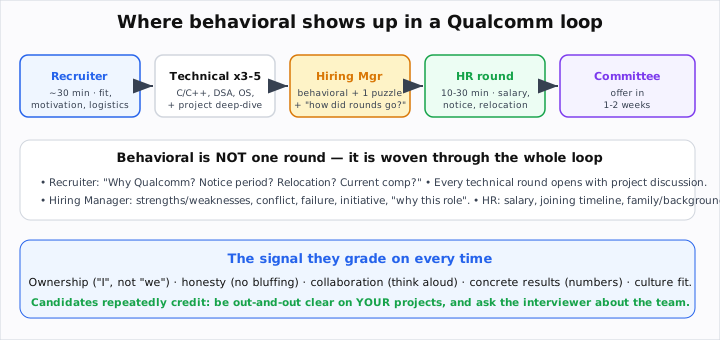
Table of contents¶
- A. The frameworks — A1 STAR method · A2 tell me about yourself · A3 the project pitch / resume walk-through · A4 going deep on a project
- B. Motivation & fit — B1 why Qualcomm · B2 why this role/domain · B3 why are you leaving · B4 why should we hire you / describe yourself in 3 words · B5 what do you know about us / competitors
- C. Self-assessment — C1 strengths & weaknesses · C2 greatest achievement · C3 goals / where in 5 years
- D. Behavioral stories (STAR) — D1 challenge/failure · D2 conflict/disagreement/teamwork · D3 initiative & a runtime/perf improvement · D4 ambiguity & tight deadlines · D5 how you handle pressure · D6 a task you disliked / unfamiliar task · D7 how you dealt with interview rejections
- E. HR logistics — E1 salary expectation · E2 notice period & joining timeline · E3 relocation & location preference · E4 offers in hand / will you join · E5 family & background
- F. The meta-round — F1 questions to ask the interviewer · F2 hiring-manager round expectations · F3 dos and don'ts · F4 the rapid-fire behavioral round
- § Encyclopedia — searchable glossary
- § Last-5-minutes cheat sheet
A. The frameworks¶
A1 · Q: Walk me through how you structure a behavioral answer. (The STAR method.)¶
Frequency: ◽ Foundational — never asked by name, but it is the scaffold under every "tell me about a time…" question (D1–D7), which collectively appear in the majority of reports.
Concept — the basis. STAR is a four-beat structure for any "tell me about a time you…" question: Situation → Task → Action → Result. It exists because, under pressure, people either ramble (all context, no point) or under-answer (a one-line "yeah I fixed a bug"). STAR forces a complete, evidence-bearing story in ~2 minutes, and — critically — it makes your individual contribution legible, because the Action beat is told in the first person.

The time budget is the part most people get wrong. Spend airtime roughly: - Situation (~15%) — one or two sentences of context. Just enough that the stakes are clear. - Task (~15%) — the specific goal you owned and the constraint (deadline, resource, ambiguity). - Action (~55%) — the bulk. What you did, step by step, in the first person ("I profiled…", "I proposed…", "I wrote…"). This is the only beat the interviewer is actually grading you on. - Result (~15%) — the outcome with a number ("cut frame latency 35%", "shipped to 3 sensor variants", "zero field crashes in the next release"), plus one line of what you learned.
Worked example — the skeleton filled with a camera/embedded story:
S: "On the preview pipeline for a mid-tier phone, our camera-open-to-first-frame time had regressed to ~900 ms — users saw a visible lag tapping the camera icon." T: "I owned the HAL-side init path and was asked to get it back under 500 ms before the next release branch." A: "I instrumented the path with timestamps, found two synchronous sensor-register reads blocking on I2C, and a buffer pool we were allocating lazily on first frame. I moved the pool allocation to init, batched the register reads, and made the 3A warm-up run in parallel with stream-on. I reviewed the change with the sensor-driver owner to make sure the batched reads were safe." R: "First-frame time dropped to ~430 ms — a ~52% improvement — and it shipped in that release. The lesson I took was to instrument before guessing; my first hypothesis (it's the ISP) was wrong."
Why it exists. Interviewers are pattern-matchers running many candidates. A STAR answer lets them extract the four things they need — was there real difficulty, did this person personally do the work, did it land, did they reflect — without having to interrogate you for them. A non-STAR answer ("we had a problem and we solved it, it was a good team") gives them none of that, so they have to dig, and digging reads as "the candidate isn't being clear."
Where you see it (Qualcomm). Every hiring-manager and HR round, and the behavioral slice of mixed technical rounds. Report 5 (Computer Vision Engineer) and Report 10 (CV) list a dedicated 30-minute "Introduction & Behavioral" section; Report 17 (SDE-1) hit a "rapid-fire behavioral" volley; Report 2's HM round and Report 40's Manager/HR round are pure behavioral. The collected tip "think aloud and collaborate" is the live-coding cousin of the same skill: show your reasoning, don't just emit a result.
Answer. "I use STAR: a sentence of Situation for context, the Task I owned, then most of my airtime on the Actions I personally took — in the first person — and I close on the Result with a concrete number and what I learned. Keeping Action in 'I, not we' is what makes my own contribution clear."
Solution / good example — a reusable STAR template.
S — "Context: [product/team]. The problem mattered because [stakes/metric]."   (1-2 sentences)
T — "My job was to [specific goal] under [constraint: deadline / ambiguity / resource]."
A — "So I: (1) [diagnose], (2) [propose/decide + WHY this over the alternative],
        (3) [execute], (4) [collaborate / de-risk / verify].  ← all 'I', ~55% of airtime
R — "Result: [metric moved by X] / [shipped to N]. What I'd improve / learned: [one line]."
Follow-ups / gotchas. (1) The #1 failure is drowning in Situation then saying "we did X" — no measurable result, no personal ownership. (2) Don't use "we" as a hiding place; if it truly was a team effort, say what your slice was. (3) Have a negative result ready too — a story where it didn't fully work but you learned something is often stronger than a flawless one (it proves reflection). (4) Pre-build 4–5 stories that each cover multiple competencies (one good "perf-improvement" story can also serve "initiative" and "conflict"). Cross-link: the technical depth behind any story lives in the topic files.
Seen in: Reports 5, 10 (dedicated behavioral sections), 17 (rapid-fire), 2, 40 (HM/Manager rounds), 42 (HR scenario-based), B9 (collaboration weighted on whiteboard).
A2 · Q: Tell me about yourself. / Introduce yourself. (2–3 minutes.)¶
Frequency: 🔥🔥🔥 Very common (~10+ reports) — the single most common opener in the entire loop; it begins most technical Round 1s and the HR round.
Concept — the basis. This is not a request for your life story or a recital of your resume (they have the resume). It is the interviewer handing you the microphone to frame the narrative before they start probing. A strong answer is a ~90-second trailer: it advertises the 2–3 things you most want them to ask about, and it ends pointing straight at this role. The cleanest structure is Present → Past → Future.

- Present — who you are now: role, years of experience, and the domain you own (camera/ISP, embedded C/C++, kernel/drivers, ML).
- Past — how you got here: one or two highlights that prove the domain and carry a metric, chosen because they map to the job description.
- Future — why you're in this room: what you want next, framed so it lands on Qualcomm and this team.
Why it exists. It sets the tone, calms both of you, and — most importantly — it lets you plant hooks. Whatever you mention, they will likely pull on ("you said you cut latency 30% — how?"). So you control the first few minutes of questioning by choosing what to surface. It also screens for basic communication: can you be concise, structured, and relevant?
Where you see it (Qualcomm). Report 11 (ML/System): "self-introduction, 2–3 minutes" opens Technical Round 1. Reports 12, 18, 19, 42 open with it; Reports 36, 39, 43 ask it in the HR/HM round; Report 18's HR round is literally "self-introduction, motivation, background, relocation." It recurs at both the technical opener and the HR close, sometimes in the same loop.
Answer. "I keep it to about 90 seconds in Present–Past–Future form: who I am and the domain I own now, one or two past highlights with a metric that map to this role, and what I want next — landing on why that's exactly this team. It's a trailer, not the whole movie; I deliberately leave hooks for them to pull on."
Solution / good example — a worked template (adapt the brackets).
"I'm a [systems/camera/embedded] engineer with [N] years at [company], where I work on [camera HAL / ISP tuning / kernel drivers / C++ pipeline code]. (Present) Most recently I [owned the X path / debugged a Y issue] and [cut latency 30% / removed a class of field crashes / brought up a new sensor] — I really enjoy the part of the job that's [low-level debugging / squeezing perf out of constrained hardware / making the camera feel instant]. Before that I [did Z — one line that shows range]. (Past) I'm looking to go deeper into [mobile camera systems / SoC-level work], on hardware that ships to hundreds of millions of users — which is why [this team at Qualcomm] is exactly the move I want, since you're doing [Spectra ISP / Snapdragon camera / driver] work at a scale I can't get anywhere else. (Future)"
For a fresher: lead with degree + the one project closest to the role, the tech you used, and one specific thing you built; then internships/competitions; then "I want to start my career in [domain] and Qualcomm's [product] is where I'd learn the most."
Follow-ups / gotchas. (1) Don't start at birth or list every job — front-load what's relevant to this role. (2) Tailor it to the JD; the camera-team version and the modem-team version are different. (3) Keep it professional; hobbies/family belong only if asked (note: some India HR rounds — Reports 17, 39, 43, 51 — do ask about family/background; answer briefly and pivot back to fit). (4) End with a hook into "why this role," so the natural next question is one you've prepared. (5) Have a 30-second version and a 90-second version; read the room.
Seen in: Reports 11, 12, 18, 19, 36, 39, 42, 43 (and the foundit list: "Introduce yourself", "Can you describe yourself in three words?").
A3 · Q: Walk me through your resume. / Explain a project from your resume. / Tell me about your most challenging project.¶
Frequency: 🔥🔥🔥 Very common (~20+ reports) — a project deep-dive opens essentially every technical round and is explicitly the most-emphasized prep tip across the dataset.
Concept — the basis. This is where the interview is won or lost for many candidates, and where the dataset's loudest advice applies: "be out-and-out clear with YOUR projects and CV." A project pitch is a five-beat structure delivered in ~3 minutes, after which the interviewer drives the zoom — they pick which beat to drill into. Your job is to give a crisp headline, then have one layer of depth below every claim you make.

- Context — what the product/system/team was, in one jargon-free sentence.
- Problem — the specific pain or wrong metric (latency, a recurring crash, power draw, a bug class, a cost). Lead with this, not the tech.
- Your role — what exactly you did. In a team project, carve out your slice explicitly: "I owned the buffer-management layer."
- Tech choices & why — the key decisions, the trade-offs, and at least one alternative you considered and rejected. ("I used a fixed pool instead of malloc-per-frame because the path was real-time and couldn't tolerate allocation jitter.")
- Impact with metrics — the result in numbers, and where it shipped. Then, unprompted or on ask: what you'd do differently.
Why it exists. Three things at once: (a) it verifies the resume is yours and not embellished — bluffing collapses the instant they ask "why that data structure?"; (b) it probes depth — can you explain why, not just what; and (c) it's a proxy for how you'll communicate design decisions on the job. The "challenging project" variant (Report 14 is only this question) additionally probes how you handle difficulty.
Where you see it (Qualcomm). Universal. Report 5 has a 30-min "Project Discussion … justify your technical choices"; Report 62's HM round is a "resume/project deep-dive (role and contributions to runtime improvements)"; Reports 11, 15, 16, 19, 20, 22, 42, 45 all open or pivot on project discussion; Report 14 and Report 54 are entirely "tell me about your project." The foundit list: "Describe your final year project in detail. How would you describe your role in the same?"
Answer. "I lead with the problem and the result — the headline — then walk Context → Problem → my Role → key Tech choices and why → Impact with numbers, in about three minutes. Then I let the interviewer pick what to drill into, and I make sure I know one layer below every claim I make: why that algorithm, what the hardest bug was, what I'd change. The cardinal sin is a five-minute 'we used X, Y, Z' monologue with no problem, no I, and no number."
Solution / good example — a worked pitch (camera/embedded flavor).
Context: "I worked on the camera HAL for a Snapdragon-class platform — the layer between the Android framework and the sensor/ISP drivers." Problem: "Switching from the wide to the tele lens had a visible ~300 ms black frame; QA filed it as a launch blocker." Role: "I owned the lens-switch state machine in the HAL. The ISP and sensor-driver teams owned their sides; I drove the cross-team root-cause." Tech & why: "I added trace markers across the switch, which showed we were tearing down and re-creating the entire ISP stream config instead of reconfiguring it. I designed a warm hand-off: keep both sensor streams primed and swap the active one, rather than stop/reconfigure/start. I chose to pre-warm rather than cache full configs because memory was tight on the mid-tier SKU — that was the key trade-off." Impact: "The black frame dropped from ~300 ms to under one frame interval (~16 ms at 60 fps); it shipped and cleared the blocker. What I'd do differently: I'd have added the trace markers first — I burned a day on a wrong guess about the sensor before I instrumented."
Follow-ups / gotchas. (1) Never claim what you can't defend one level down. If you say "I used a hash map," be ready for "why not a tree?" (2) Pick a project that's yours and relevant — not the most impressive-sounding one you barely touched. (3) Quantify or it didn't happen; if you have no hard metric, use a relative one ("roughly halved the crash rate"). (4) For team projects, the interviewer is listening for whether you say "we" everywhere — explicitly stake out your contribution. (5) Have 2–3 projects queued at different depths; they may ask for "another one." (6) Prep the "what would you do differently" answer in advance — volunteering it signals maturity. Cross-link: the algorithm/driver/ISP internals you'll be quizzed on are in the topic files.
Seen in: Reports 5, 11, 14, 15, 16, 19, 20, 22, 42, 45, 54, 62 (and foundit "describe your final-year project and your role"). Tip from Report 22: "Be out and out clear with your projects and CV."
A4 · Q: (Deep-dive follow-ups) Why did you choose X? What was the hardest bug? What would you do differently?¶
Frequency: 🔥🔥 Common (~7 reports) — the second wave after A3; the interviewer "drives the zoom."
Concept — the basis. Once you've pitched (A3), the interviewer stops you and zooms into one beat. These follow-ups separate "narrated a project" from "actually did the engineering." The three canonical zooms: - "Why did you choose [tech/design]?" — wants the trade-off, not just the choice. Answer with the alternative you rejected and the constraint that decided it. - "What was the hardest part / the worst bug?" — wants a real war story: the symptom, how you narrowed it, the aha. Heisenbugs, race conditions, and "works on my machine" stories shine here. - "What would you do differently / what did you learn?" — wants reflection and the absence of ego. Give a genuine improvement, not a humble-brag ("I'd document more" is weak; "I'd instrument before hypothesizing" is real).
Why it exists. It's the truth-test for the resume. Surface knowledge survives the pitch; only real ownership survives the third "why." It also probes engineering judgment — do you reason about trade-offs, or did you cargo-cult a choice?
Where you see it (Qualcomm). Report 62: HM "resume/project deep-dive (role and contributions to runtime improvements via code changes)" — then a Singleton-with-thread-safety implementation, i.e. they go from your claim straight into "show me." Report 11, 12, 15, 16 all describe "project discussion with cross-questioning." Report 12 explicitly: "interviewer provided continuous hints throughout" — collaboration is being graded even here.
Answer. "I expect them to zoom in, so for each project I prepare the three classic follow-ups: why this choice (answered as a trade-off against the alternative I rejected), the hardest bug (symptom → how I narrowed it → the fix), and what I'd do differently (a real lesson, not a humble-brag). I treat 'continuous cross-questioning' as collaboration, not interrogation — I think aloud and welcome the hints."
Solution / good example.
Q: "Why a fixed-size pool instead of malloc per frame?" "Two reasons. First, the path was on the per-frame deadline —
malloccan take a variable, occasionally long time when it has to go to the OS or coalesce, and a single missed deadline is a dropped frame. A pool is O(1) and jitter-free. Second, long-running camera use fragments the heap, so a per-framemalloccan start failing after hours even with free memory. The cost was up-front memory I had to size for the worst case — that was the trade-off I accepted." (Cross-link: heap/fragmentation/pools →01_c_programming.md, real-time allocation →04_os.md.)
Follow-ups / gotchas. (1) "I don't remember" on your own project is the worst possible answer — re-read your own code/design before the interview. (2) It's fine to say "I'd have to check the exact number, but it was roughly…"; it's not fine to invent a precise number you'll contradict later. (3) If they push past your knowledge, say so honestly and reason from fundamentals — that beats bluffing every time (the dataset's "don't bluff" tip, Report 19). (4) Treat hints as a gift, not a failure signal.
Seen in: Reports 11, 12, 15, 16, 62 (project cross-questioning / runtime-improvement deep-dive). Tip from Report 19: "Don't bluff in the interviews, it won't help."
B. Motivation & fit¶
B1 · Q: Why do you want to join Qualcomm?¶
Frequency: 🔥🔥🔥 Very common (~8 reports) — a staple of the recruiter screen and the HR/HM round.
Concept — the basis. "Why Qualcomm" tests whether you've done your homework and whether your motivation is specific and durable (will you stay) versus generic ("big brand, good pay"). A strong answer connects (a) something concrete about Qualcomm — a product, a technology, the scale — to (b) something true about you — your domain, what you want to build. Generic praise ("Qualcomm is a great innovative company") is a red flag; it shows you'd say the same to any employer.
Facts worth knowing (verified): Qualcomm was founded in 1985 by Irwin Jacobs and six co-founders, is headquartered in San Diego, and is the wireless/SoC leader behind the Snapdragon platform and the Spectra Image Signal Processor (the camera ISP block — the Snapdragon 8-class Spectra moved from 14-bit to an 18-bit pipeline). Its stated values, "The QUALCOMM Way," are Win Together, Achieve Excellence, Make the Impossible Inevitable, Do the Right Thing.
Why it exists. Recruiters and HMs are screening for flight risk and fit. Someone who wants Qualcomm specifically — for the camera/SoC work, the scale, the depth — is likelier to be engaged and to stay. It also reveals whether you understand what the company actually does (you'd be amazed how many candidates conflate Qualcomm with a phone maker).
Where you see it (Qualcomm). Report 11 (HR), Report 18 (HR: "motivation for joining Qualcomm"), Report 19 (candidate asked the interviewer about Snapdragon/5G — and credited it), Report 35/46 ("Why this role?"), foundit list ("Why do you want to join Qualcomm?", "What do you know about our competitors?"). Report 12 closes with "motivation for joining Qualcomm and technology interests."
Answer. "I anchor it on something concrete about Qualcomm tied to something true about me — not generic praise. For a camera role: the chance to work on the Spectra ISP and Snapdragon camera stack, shipping to hundreds of millions of devices, is depth and scale I can't get elsewhere; that's exactly the direction I want my career to go."
Solution / good example.
"Two reasons, one about the work and one about the scale. The work: I've been doing [camera HAL / embedded C++ / kernel-driver] work, and Qualcomm is the place that does it at the metal — the Spectra ISP and Snapdragon camera pipeline are exactly the systems I want to go deeper on, and very few companies even have an in-house ISP. The scale: code I write here ships in hundreds of millions of devices, so the bar for performance, power, and reliability is real — that constraint is what I find motivating, not a turn-off. And the engineering culture is known for depth and rigor, which is the kind of team I want to grow in."
For why this team specifically (if you know it): name the product (camera/ISP, modem, GPU, audio) and tie it to your background.
Follow-ups / gotchas. (1) Avoid money/brand as the headline reason. (2) Don't praise things you can't discuss — if you mention Spectra ISP, be ready for "what do you know about it?" (3) "What do you know about our competitors?" (foundit) and "What do you know about our products?" are companions — have a sentence on the Snapdragon platform and where Qualcomm sits vs. e.g. MediaTek/Apple-silicon for SoCs. (4) "Why should we hire you?" is the mirror question (B4). Cross-link: camera/ISP product context → 05_camera_isp_multimedia.md.
Seen in: Reports 11, 12, 18, 19, 35, 46 (and foundit: "Why do you want to join Qualcomm?", "What do you know about our competitors?").
B2 · Q: Why this role / why this domain (camera / embedded / SoC / ML)?¶
Frequency: 🔥🔥 Common (~5 reports) — often paired with B1; Report 35 and 46 ask "Why this role?" verbatim.
Concept — the basis. "Why Qualcomm" is about the company; "why this role" is about the match between the job's day-to-day and your demonstrated interests. The strongest answer shows a through-line: your past work, the thing you enjoy about it, and how this role is the natural next step. For a domain switch (e.g. into camera with no camera background — see Report B1's Reddit poster), you reframe transferable skills honestly rather than pretending experience you lack.
Why it exists. It probes genuine interest (which predicts engagement and tenure) and self-awareness (do you know what this job actually involves day to day). A camera role is sensor/ISP/HAL debugging and image-quality work; an embedded role is drivers, RTOS, and bring-up; a modem role is signal processing and protocol. Naming the real daily work signals you know what you're signing up for.
Where you see it (Qualcomm). Reports 35 & 46: "Why this role?" Report 5/10: "career motivation questions." Report 4's managerial round: "career motivation … comfort level with video processing." Report 12: "technology interests." The CleverPrep camera guide weights "interest in mobile camera dev" and "passion for computational photography."
Answer. "I draw a through-line: here's the part of my current work I love, here's why this role is more of exactly that, and here's the specific day-to-day — sensor/ISP/HAL debugging and image-quality work — that I'm signing up for. If I'm switching domains, I'm honest about it and I lead with the transferable skills plus what I've done to close the gap."
Solution / good example.
(Camera role, with adjacent experience): "The part of my job I consistently enjoy most is the low-level debugging across hardware and software boundaries — when a bug could be in the sensor, the driver, or my code, and I have to instrument the whole path to find it. A camera role is that, full-time: sensor → ISP → HAL → framework, plus the image-quality side I find genuinely interesting. I've been reading up on the ISP pipeline — demosaic, denoise, 3A, tone-mapping — and I want to go from adjacent to deep, which is exactly what this role offers."
(Honest domain switch): "I'll be upfront — my direct camera experience is limited. But the core of the role is embedded C/C++, debugging across the HW/SW stack, and performance under tight constraints, which is exactly what I've done in [modem / audio / kernel]. I've spent the last few weeks getting fluent in the ISP pipeline and Android camera architecture so I can ramp fast, and I'm drawn to camera because [specific reason]."
Follow-ups / gotchas. (1) Don't say "I'll take any role" — it reads as no real interest. (2) If switching domains, don't pretend; the technical round will expose it. Lead with transferable skills + evidence you've started closing the gap (the Report B1 poster's exact dilemma). (3) Be ready for "what do you find interesting about [domain] specifically?" — have one genuine technical hook (e.g. "computational photography turning multiple frames into one better image"). Cross-link: domain depth → 05_camera_isp_multimedia.md, 07_embedded_linux_kernel.md, 06_ml_deeplearning.md.
Seen in: Reports 4, 5, 10, 12, 35, 46 (and CleverPrep camera guide "interest in mobile camera dev / passion for computational photography"); B1 (Reddit camera-without-background dilemma).
B3 · Q: Why are you leaving your current company? / Why do you want to change?¶
Frequency: 🔥 Occasional (~3 reports) — standard in the HR/HM round and the recruiter screen.
Concept — the basis. This is a landmine framed as small talk. The interviewer is checking whether you'll badmouth an employer (a culture-fit red flag), whether your reasons are constructive (pulling toward growth) rather than destructive (running from a problem), and whether the problem you're escaping might recur here. The rule: frame everything positively and forward-looking — toward what Qualcomm offers — and never trash your current manager, team, or company.
Why it exists. How you talk about your last employer predicts how you'll talk about this one. Bitterness, blame, or oversharing about office politics signals you'll be a morale problem and may leak internal matters. Conversely, a growth-framed answer signals professionalism and self-direction.
Where you see it (Qualcomm). Report 39's HR: "main concern was whether candidate will join or not" (the flip side of why-you'd-leave). Report 51's managerial round: "previous companies." Implicit whenever you discuss current work in the HM round (Reports 2, 40, 62 all open the HM/HR round with "previous company and projects"). The foundit list includes "Describe a situation wherein you were asked to do something you didn't like? How did you handle it?" — the same don't-badmouth muscle.
Answer. "I keep it forward-looking: I've grown a lot where I am, but I want to go deeper into [camera/SoC/embedded] at a scale and depth that Qualcomm specifically offers, and that's the pull. I never frame it as running away from my current employer — even if there were frustrations, I talk about what I'm moving toward."
Solution / good example.
"I've genuinely valued my time at [company] — I learned [X] and got to own [Y]. What I'm looking for now is depth in [camera/SoC] at scale: my current product reaches [small/niche] users, and I want to work on systems that ship to hundreds of millions of devices, where the performance and reliability bar is much higher. That kind of deep, high-scale [ISP/embedded] work is exactly what Qualcomm does and what my current role can't give me — so it's a pull toward the work, not a push away from my team."
If the real reason is comp or a bad manager, reframe: comp → "I'm looking for growth and the right level of challenge" (and handle money in the salary question, E1); bad manager → "I'm looking for a team with deeper technical mentorship in [domain]."
Follow-ups / gotchas. (1) Never badmouth — not the company, manager, or teammates; assume the interviewer might know them. (2) Don't make it only about money even if it is — that reads as a flight risk who'll leave again for $1 more. (3) Don't overshare drama or confidential details. (4) If you were laid off / the project was cancelled, state it factually and neutrally ("the program was wound down") and pivot to what you're looking for. (5) Keep it short — this is not the place to dwell.
Seen in: Reports 2, 39, 40, 51, 62 (previous-company / will-you-join framing); foundit ("a situation you didn't like — how did you handle it").
B4 · Q: Why should we hire you over other candidates? / Describe yourself in three words. / What is your greatest strength as a candidate?¶
Frequency: 🔥 Occasional (~2–3 reports) — foundit explicitly; recurs in HM rounds.
Concept — the basis. This asks you to make your own case concisely. It's a sales question, but the currency is evidence, not adjectives. Pick 2–3 differentiators that match the JD and back each with a one-line proof. The "three words" variant is the compressed version — choose words that are demonstrable (e.g. "tenacious, low-level, collaborative") and have a one-sentence example ready for each.
Why it exists. It tests self-awareness (do you know your actual strengths), prioritization (can you pick the relevant ones), and confidence without arrogance. "Over other candidates" specifically wants your differentiator — what's the combination only you bring.
Where you see it (Qualcomm). foundit list: "Why should we hire you over other candidates?", "Can you describe yourself in three words?", "Tell me one thing you hate the most." Report 20's HM round: "What is your greatest Achievement?" (a close cousin — see C2). HM rounds generally invite a "make your case" moment.
Answer. "I name two or three differentiators that map to the role and prove each in a sentence. For a camera/embedded role: deep low-level debugging across the HW/SW boundary, a track record of shipping performance improvements with real numbers, and that I'm easy to work with cross-team — and I give a one-line example for each rather than just asserting them."
Solution / good example.
"Three things. First, I'm strong at cross-boundary debugging — finding the bug when it could be in the sensor, the driver, or my code; I did exactly that to kill a [300 ms lens-switch glitch]. Second, I ship measurable performance wins — I've cut [first-frame latency 50%], and I instrument before I guess. Third, I work well across teams — that lens-switch fix needed the sensor and ISP owners, and I drove the joint root-cause. So: low-level depth, measurable impact, and collaboration — that combination is what I'd bring here."
(Three words): "Tenacious — I don't drop a hard bug; I once chased a race condition for a week until I caught it. Low-level — I'm most comfortable at the metal, in C/C++ and drivers. Collaborative — I think out loud and bring the right owners in early."
Follow-ups / gotchas. (1) Don't list ten things — 2–3, each with proof. (2) Match the JD: for camera, lead with debugging/imaging; for kernel, lead with drivers/memory. (3) "Tell me one thing you hate the most" (foundit) is a curveball — keep it light and professional (e.g. "flaky, unreproducible bugs — which is also why I over-invest in good logging"). (4) Don't be arrogant ("I'm the best engineer you'll see"); let the evidence carry the confidence.
Seen in: Report 20 ("greatest achievement"); foundit ("why should we hire you", "describe yourself in three words", "one thing you hate the most").
B5 · Q: What do you know about Qualcomm / our products / our competitors?¶
Frequency: 🔥 Occasional (~2 reports) — foundit explicitly; implicit in "why Qualcomm."
Concept — the basis. A homework check. They want to see you can name what Qualcomm makes and where it sits in the market — at least at a literate-outsider level, ideally tied to the team you're interviewing for. You don't need analyst-grade detail; you need to not embarrass yourself and to show genuine interest.
The literate baseline (verified): Qualcomm is the fabless wireless/SoC leader, best known for the Snapdragon platform (the SoC in a huge share of Android phones), with in-house blocks including the Spectra ISP (camera), Adreno GPU, Hexagon DSP/NPU (AI), and Snapdragon modems (4G/5G). It's a patent/licensing powerhouse in cellular standards. Competitors depend on the segment: in mobile SoCs, MediaTek, Apple silicon, and (historically) Samsung Exynos; in modems, fewer rivals.
Why it exists. It separates "applied because it's a famous company" from "applied because I understand and want what they build." Naming the relevant block (Spectra for camera, Hexagon for ML, modem for wireless) shows targeted interest.
Where you see it (Qualcomm). foundit list: "What do you know about our competitors?" Report 19: candidate proactively discussed Snapdragon and Qualcomm's leadership in wireless/4G/5G with the interviewer and credited it as helpful. Report 39's tip: "for HR interview, know about the company, PPT and website."
Answer. "I keep a literate baseline ready: Qualcomm is the fabless SoC and wireless leader behind Snapdragon, with in-house IP like the Spectra ISP, Adreno GPU, Hexagon NPU, and Snapdragon modems, plus a major cellular patent portfolio. Then I tie it to my team — for camera, I'd talk about Spectra and the Snapdragon camera stack — and name the relevant competitors only if asked."
Solution / good example.
"Qualcomm is the fabless wireless and SoC leader — the Snapdragon platform powers a big chunk of the Android market, and what's striking is how much is in-house: the Spectra ISP for camera, Adreno GPU, Hexagon for AI, and the Snapdragon modems that come from your cellular leadership. For the role I'm interviewing for, the camera/ISP side is what draws me — owning the image pipeline end to end is rare. On competition, in mobile SoCs you're up against MediaTek and Apple's silicon, but the integrated ISP-plus-modem-plus-AI story is a real differentiator."
Follow-ups / gotchas. (1) Don't bluff specifics (exact chip model numbers, financials) — a confident wrong fact is worse than a general right one. (2) Tie it to your team; generic company facts are table stakes. (3) Read the company's careers/about page and recent Snapdragon announcements the night before (Report 39's tip). (4) If asked competitors, be respectful — don't trash rivals.
Seen in: Report 19 (Snapdragon/5G discussion credited), Report 39 (tip: know the company/website); foundit ("what do you know about our competitors?").
C. Self-assessment¶
C1 · Q: What are your strengths and weaknesses?¶
Frequency: 🔥🔥🔥 Very common (~8 reports) — one of the most-listed behavioral questions in the dataset (Reports 5, 10, 43, and more).
Concept — the basis. Strengths: pick 2–3 that match the role and back each with a concrete example (same evidence discipline as B4). Weaknesses: the question is not "do you have flaws" — everyone does — it's "are you self-aware and do you actively manage them." A good weakness answer has three parts: (1) a real weakness (not a disguised brag), (2) why it's a weakness / when it bites, and (3) a genuine mitigation plan you already practice. The dataset is explicit here: Report 42's tip is "back weaknesses with mitigation plans."
Why it exists. Strengths test relevance and evidence; weaknesses test honesty and growth mindset. The classic failure is the humble-brag ("my weakness is I work too hard / I'm a perfectionist") — interviewers have heard it a thousand times and read it as evasive. A candidate who names a real gap and shows they're managing it reads as trustworthy and coachable.
Where you see it (Qualcomm). Reports 5 & 10 (dedicated behavioral section: "strengths and weaknesses"), Report 43 (HR panel: "strengths and weaknesses"). Report 42's tip explicitly: "back weaknesses with mitigation plans" and the interviewer there even "questioned the candidate's English course completion" — i.e. they probe the mitigation.
Answer. "For strengths I pick 2–3 that fit the role, each with a one-line proof. For weaknesses I give a real one — not a disguised strength — say when it bites me, and then the mitigation plan I already practice. The honesty plus an active fix is the whole point; the humble-brag weakness backfires."
Solution / good example.
Strengths: "My strongest is debugging persistence — I'm the person who stays on a non-reproducible bug until it's caught; I chased a race condition for a week and found it. Second is measurable performance work — I cut [first-frame latency 50%] and I instrument before guessing. Both map directly to camera/embedded work."
Weakness (worked, with mitigation): "A real one: earlier in my career I'd dive into code before fully scoping the problem — I'd start fixing the first plausible cause and sometimes solve the wrong thing. It bit me on the latency project: I lost a day on a wrong hypothesis. So now I have a deliberate habit — I instrument and reproduce first, write down the actual hypothesis, and only then touch code. It's made me slower to start but much faster to finish, and I've stopped chasing wrong leads."
Other genuinely-mitigatable weaknesses: over-committing/saying yes too much → "I now estimate before committing and flag conflicts early"; weak at delegating → "I consciously hand off and document instead of hoarding tasks"; shaky public speaking → "I joined a speaking group / I rehearse design reviews."
Follow-ups / gotchas. (1) Never use a fake weakness ("perfectionist", "I care too much"). (2) Don't pick a weakness that's fatal to the role ("I'm bad at C" for a C role). (3) The mitigation must be something you already do, not a vague intention — they'll probe it (Report 42). (4) Keep it to one well-handled weakness; you don't need to confess three. (5) Don't make the weakness so trivial it's insulting ("I sometimes drink too much coffee"). (6) End on the upswing — the improvement, not the flaw.
Seen in: Reports 5, 10, 43 ("strengths and weaknesses"); Report 42 (tip: "back weaknesses with mitigation plans"; interviewer probed the candidate's mitigation).
C2 · Q: What is your greatest achievement?¶
Frequency: 🔥 Occasional (~2 reports) — Report 20 verbatim in the HM round.
Concept — the basis. A STAR-shaped question (A1) where the Result is the headline. Pick an achievement that is (a) yours, (b) relevant to the role's competencies, and (c) carries a number or clear stakes. It can be a shipped feature, a hard bug killed, a perf win, or a leadership moment — but it should let you show the same skills the job needs.
Why it exists. It reveals what you consider valuable (which signals what kind of engineer you are) and gives another chance to demonstrate ownership and impact. An achievement framed as "we shipped a thing" wastes it; one framed as "I personally solved X, here's the number" is gold.
Where you see it (Qualcomm). Report 20: "What is your greatest Achievement?" in the managerial/on-site round. Overlaps heavily with the project deep-dive (A3) and the initiative story (D3) — often the same story, told to emphasize the outcome.
Answer. "I pick something that's genuinely mine, relevant to the role, and has a number — usually a shipped perf win or a hard bug I personally cracked — and I tell it STAR-style with the Result as the headline, so it doubles as proof of ownership and impact."
Solution / good example.
"My proudest is the camera first-frame latency work. The open-to-first-frame had regressed to ~900 ms — a launch-quality problem. I owned the fix: I instrumented the path, found blocking I2C reads and a lazily-allocated buffer pool, moved allocation to init, batched the reads, and parallelized 3A warm-up. It dropped to ~430 ms — over 50% — and shipped. I'm proud of it because it was measurable, it was mine end-to-end, and it directly improved how the product felt to every user."
Follow-ups / gotchas. (1) Don't pick something irrelevant (a sports trophy) for a technical HM round unless they steer personal. (2) Make the result concrete. (3) Be ready for "what made it hard?" and "what would you do differently?" (A4). (4) Don't claim a team win as solely yours — stake out your slice honestly.
Seen in: Report 20 ("What is your greatest Achievement?").
C3 · Q: Where do you see yourself in 5 years? / How do you set your goals? / Career aspirations?¶
Frequency: 🔥 Occasional (~3 reports) — Reports 22, 39 ask "aspirations / 1-year outlook"; foundit asks the goals question.
Concept — the basis. The interviewer is checking that your trajectory plausibly includes staying at Qualcomm and growing in this domain — not that you have a rigid life plan. The safe, honest frame: deepen technical mastery in this domain, take on more scope/ownership, and grow toward (your genuine preference) a technical-depth track (senior/principal/architect) or a lead/management track. Tie it to the kind of work Qualcomm offers so the answer implies tenure.
Why it exists. Flight-risk and fit again. They want signal that the role is a step on your path, not a stopgap. It also reveals self-direction — do you have a sense of where you're going?
Where you see it (Qualcomm). Report 22: "Career aspirations (1-year outlook)" and "aspirations / culture fit" in the HR round. Report 39's tip references it. foundit list: "How do you define your goals in life? Do you make plans and strategies for the future or grab opportunities as they come?"
Answer. "I frame it as deepening technical mastery in this domain, taking on more ownership and scope, and growing toward [senior/architect or lead] — and I tie it to the work Qualcomm offers, so it naturally implies I see myself growing here, not using this as a stopgap."
Solution / good example.
"In one year, I want to be the person the team trusts to own a chunk of the [camera HAL / driver / pipeline] independently and to have shipped a couple of meaningful improvements. In five years, I see myself with deep technical mastery of the camera/SoC stack — the kind of engineer who's the go-to for hard cross-layer problems, and ideally growing toward a [technical architect / tech-lead] role. The reason that maps to Qualcomm is that this is one of the few places where I can go that deep on imaging at that scale, so my growth and staying here point the same direction."
Follow-ups / gotchas. (1) Don't say "I want to start my own company" or "I'm not sure" — both read as short-tenure. (2) Don't over-commit to management if you actually want IC depth (or vice-versa) — be genuine; both are fine. (3) Keep it tied to the domain/company, not "I'll be a director somewhere." (4) For the "plans vs. grab opportunities" framing (foundit), a balanced answer wins: "I set a direction but stay opportunistic about the right projects."
Seen in: Reports 22, 39 (aspirations / 1-year outlook / culture fit); foundit ("how do you define your goals … plans vs. opportunities").
D. Behavioral stories (STAR)¶
D1 · Q: Tell me about a challenge or a failure, and what you learned.¶
Frequency: 🔥🔥 Common (~5 reports) — Reports 5, 10 ("handling challenges"), 14 ("challenging project"); foundit variants.
Concept — the basis. A pure STAR story (A1) where the point is what you learned, not that you're flawless. For a failure question specifically, you must pick a real failure (not a disguised success) and land the answer on the lesson and the changed behavior. The arc: real difficulty/failure → what you did → honest outcome (even if imperfect) → concrete lesson you now apply.
Why it exists. It tests resilience, honesty, and growth. A candidate with no failures is either inexperienced or not self-aware; one who owns a failure and shows the lesson reads as senior. It also tests judgment: do you take responsibility, or blame others/circumstances?
Where you see it (Qualcomm). Reports 5 & 10: "How do you handle challenges?" in the behavioral section. Report 14: the entire interview is "tell me about the challenging project." Report 4's managerial round probes difficulty. The CleverPrep camera guide: "Describe a time you debugged a complex image quality issue."
Answer. "I give a real one in STAR form and put the weight on the lesson. For a 'failure' I deliberately pick something that genuinely didn't fully work, own my part of it, and end on the specific behavior I changed afterward — owning it and showing the change is the whole signal."
Solution / good example (failure flavor).
S: "On a tight release, I pushed a buffer-management change to fix a memory leak in the camera HAL." T: "I needed the leak gone before the branch cut, and I was confident in the fix." A: "I tested it on my bench device and it looked clean, so I merged. But I'd only soak-tested for an hour. In the field, under a specific burst-capture pattern, my change introduced a rare double-free that crashed the camera. When the bug came back, I owned it immediately, root-caused it with AddressSanitizer, found my ownership logic had a race under burst, and fixed it properly with a refcount." R: "It shipped a release late and was embarrassing. The lesson stuck hard: I now soak-test concurrency-sensitive changes for hours under the worst-case pattern, not minutes under the happy path — and I added an ASan CI gate so the class of bug can't recur silently. I haven't shipped a double-free since."
Follow-ups / gotchas. (1) For "failure," a disguised brag ("I worked too hard and burned out") is the cardinal sin — pick something real. (2) Own it — don't blame the team, the spec, or QA. (3) Always land on the lesson + changed behavior; a failure with no learning is just a failure. (4) Don't pick a catastrophic, trust-destroying failure (you got someone fired); pick a real-but-recoverable one. (5) The "challenge" (vs "failure") variant can end in success — but still emphasize the hard part and the lesson. Cross-link: the debugging tooling (ASan/Valgrind) → 01_c_programming.md, 04_os.md.
Seen in: Reports 4, 5, 10, 14 ("handling challenges" / "challenging project"); CleverPrep ("describe a time you debugged a complex image-quality issue").
D2 · Q: Tell me about a conflict or disagreement with a teammate. / How do you handle a strict manager?¶
Frequency: 🔥🔥 Common (~4 reports) — Report 33 ("dealing with strict manager"), Report 17 (rapid-fire teamwork scenarios); foundit ("a situation you didn't like — how did you handle it").
Concept — the basis. A STAR story testing emotional maturity and collaboration. The arc the interviewer wants: a genuine disagreement → you sought to understand the other side (data/their reasoning) → you resolved it professionally (compromise, data-driven decision, or escalation done right) → a constructive outcome and a preserved relationship. The villain of a bad answer is "I was right and they were wrong"; the hero of a good one is "we found the better answer together, and I'd work with them again."
Why it exists. Engineering is a team sport across sensor/ISP/driver/apps teams (the camera loop literally has a "cross-functional interview with the sensor/apps team," Report 1). They're screening out people who can't disagree without damaging relationships, and screening in people who handle friction with curiosity and data.
Where you see it (Qualcomm). Report 33: "Dealing with Strict Manager" and "Handling Strict Deadlines and Unclear Instructions" (behavioral). Report 17: rapid-fire "how do you handle deadline conflicts?" Report 1: cross-functional round with the sensor/apps team — collaboration is explicitly evaluated. foundit: "Describe a situation wherein you were asked to do something you didn't like? How did you handle it?"
Answer. "I tell a real disagreement in STAR form and centre it on understanding the other side — I dig into their reasoning or get data, propose a path, and resolve it professionally, whether that's a compromise, letting the data decide, or escalating cleanly. The signal I want to leave is that I disagree without making it personal and I'd happily work with them again."
Solution / good example.
S: "A senior teammate and I disagreed on how to fix a frame-drop bug. He wanted to bump a buffer-pool size — a quick patch; I thought the real cause was a priority-inversion stall and that more buffers would just mask it." T: "We had to pick one before the next build, and we were both fairly sure." A: "Rather than argue from opinion, I asked to spend two hours getting data: I traced the scheduler and showed the pipeline thread was blocking on a lower-priority lock holder — classic priority inversion. I framed it as 'his patch would work short-term but here's what the trace shows,' not 'you're wrong.' We agreed to do both: my priority-inheritance fix for the root cause, and his buffer bump as a safety margin." R: "The frame drops went away and stayed away through soak. More importantly, the way we resolved it — data over ego — made us default to 'let's trace it' on the next three disagreements. We still work well together."
Follow-ups / gotchas. (1) Never make yourself the unambiguous hero and the other person an idiot — humility reads as senior. (2) Show you listened — the turn should include understanding their view. (3) For "strict manager" (Report 33): emphasize adapting to their style, clarifying expectations, and over-communicating — not resentment. (4) If the resolution was escalation, show you escalated professionally (with the disagreement framed as a decision needed, not a complaint). (5) End with a preserved/strengthened relationship. Cross-link: priority inversion technical detail → 04_os.md, 07_embedded_linux_kernel.md.
Seen in: Reports 1 (cross-functional/collaboration round), 17 (deadline-conflict rapid-fire), 33 ("strict manager", "unclear instructions"); foundit ("something you didn't like — how did you handle it").
D3 · Q: Tell me about a time you took initiative or drove a performance / runtime improvement.¶
Frequency: 🔥🔥 Common (~4 reports) — Report 62 (HM: "contributions to runtime improvements via code changes"), CleverPrep camera ("a camera feature you developed that improved image quality", "optimized camera power").
Concept — the basis. A STAR story where you spotted a problem or opportunity no one assigned to you and drove it — or, in the perf variant, measurably improved a runtime/latency/power metric. The interviewer wants proactivity + measurable impact. The perf version is gold at Qualcomm because the whole company optimizes for performance and power under constraints; come with a number.
Why it exists. Initiative predicts who'll be a force-multiplier vs. who waits to be told. The perf framing additionally tests whether you measure (good engineers quantify) and whether you understand the system deeply enough to find where the time/power goes.
Where you see it (Qualcomm). Report 62 verbatim: HM round on "role and contributions to runtime improvements via code changes." CleverPrep camera guide: "Tell me about a camera feature you developed that improved image quality" and "Describe a project where you optimized camera power consumption." This is the natural home for your strongest "I made the number better" story.
Answer. "I tell a story where I spotted the problem myself and drove the fix, and I make the result a hard number — for the perf variant especially, since Qualcomm lives on performance and power. The arc is: I noticed [metric was wrong], I instrumented to find where the cost was, I made a specific change with a clear trade-off, and the metric moved by [X]%."
Solution / good example (runtime improvement).
S: "Nobody had flagged it, but I noticed our per-frame CPU time was creeping up release over release — eating into thermal headroom on the mid-tier SKU." T: "I took it on myself to investigate before it became a thermal-throttle problem." A: "I profiled with a sampling profiler and found a per-pixel color-correction loop that wasn't vectorized and was recomputing a constant matrix every frame. I hoisted the matrix out of the loop, restructured the inner loop so the compiler auto-vectorized it (NEON), and added a fast path for the common identity case. I validated image output was bit-identical before and after so it was a pure perf change." R: "Per-frame CPU dropped ~35% on that path, which bought back thermal headroom and let us hold the target frame rate longer in video. It was self-initiated — I raised it, scoped it, and shipped it."
Follow-ups / gotchas. (1) Measure — "it got faster" is weak; "35% less per-frame CPU" is strong. (2) Show you verified correctness (image-identical, no regression) — perf wins that break output are worse than no win. (3) For "initiative," stress that it wasn't assigned — you saw it and drove it. (4) Be ready for "how did you profile?" and "why was it slow?" (A4) — know the tooling and the root cause. (5) Don't over-claim a team optimization as solo. Cross-link: profiling, SIMD/NEON, cache behavior → 09_computer_arch_digital_design.md; real-time/perf → 04_os.md, 05_camera_isp_multimedia.md.
Seen in: Report 62 ("contributions to runtime improvements via code changes"); CleverPrep camera guide ("a camera feature you developed that improved image quality", "optimized camera power consumption").
D4 · Q: How do you handle ambiguity and tight deadlines? / Unclear instructions?¶
Frequency: 🔥🔥 Common (~5 reports) — Reports 17, 33 (rapid-fire / behavioral), foundit ("couldn't finish in time — quick decision").
Concept — the basis. Two related pressures. Ambiguity: the right move is to reduce it — ask clarifying questions, make and state explicit assumptions, define a small scope, and check in early. Tight deadlines: prioritize (what's the minimum that delivers the core value), communicate trade-offs and risks early, and de-scope explicitly rather than silently slipping or burning out. The worst answers are "I just work harder" (unsustainable, doesn't address the real skill) and "I freeze without clear instructions" (no initiative).
Why it exists. Real engineering is ambiguous and time-pressured; nobody hands you a perfect spec. They're testing whether you can make progress under uncertainty and manage scope and stakeholders rather than either freezing or going heads-down and delivering the wrong thing late.
Where you see it (Qualcomm). Report 17: rapid-fire "how do you handle deadline conflicts?", "how do you handle unfamiliar tasks?", "how do you handle urgent customer requests?" Report 33: "Handling Strict Deadlines and Unclear Instructions." Report 5/10: "problem-solving under pressure." foundit: "Has there ever been a situation wherein you weren't able to complete your task in time and therefore had to take a quick decision to manage the situation?"
Answer. "For ambiguity I reduce it — clarify, state my assumptions out loud, scope small, check in early — rather than freezing or guessing silently. For tight deadlines I prioritize and communicate: deliver the core first, flag risks and trade-offs early, and de-scope explicitly with stakeholders instead of quietly slipping. 'Just work harder' isn't a strategy."
Solution / good example (ambiguity + deadline, STAR).
S: "Two days before a demo, I was asked to 'make the camera preview smoother' — no spec on what 'smoother' meant or what was acceptable to cut." T: "Deliver a visibly better preview for the demo, fast, with the goalpost undefined." A: "First I reduced the ambiguity: I asked the PM two questions — 'is it frame rate or frame latency that looks bad?' and 'is dropping resolution acceptable?' That alone narrowed it to latency. Then I prioritized: I listed three possible fixes by effort-vs-impact, picked the one I could land in a day (parallelizing 3A warm-up), and explicitly told the PM I'd do that one and not the riskier pipeline refactor before the demo. I checked in at the halfway mark with a quick clip so we could course-correct." R: "Preview latency dropped enough to be visibly smoother for the demo, on time, and because I'd scoped and communicated, nobody was surprised that the bigger refactor came in the next sprint."
Follow-ups / gotchas. (1) Don't say "I just stay late and grind" — it signals poor prioritization and isn't repeatable. (2) Show the clarifying questions explicitly — that's the core skill for ambiguity. (3) Show proactive communication of risk — surprising your manager with a slip is the failure mode. (4) "Unfamiliar task" (Report 17) → ramp strategy: read the existing code/docs, find the owner, build the smallest thing that works first. (5) Mirrors the live-coding tip: ask clarifying questions first before you code (Reports 11, 42, 44).
Seen in: Reports 5, 10, 17, 33 ("problem-solving under pressure", "deadline conflicts", "unfamiliar tasks", "urgent customer requests", "unclear instructions"); foundit ("couldn't finish in time — quick decision").
D5 · Q: How do you approach problem-solving under pressure?¶
Frequency: 🔥🔥 Common (~4 reports) — Reports 5, 10 verbatim ("problem-solving under pressure").
Concept — the basis. Closely related to D4 but framed as your general method rather than one story. They want a calm, systematic process: (1) don't panic — break the problem down; (2) gather data / reproduce before guessing; (3) form a hypothesis and test the cheapest one first; (4) ask for help/escalate when stuck rather than spinning; (5) communicate status so stakeholders aren't in the dark. Back the method with a one-line example. This is also the meta-skill the whiteboard rounds grade as "think aloud and collaborate."
Why it exists. Pressure is where engineers either fall apart or shine. A described process (vs. "I just figure it out") signals you're reliable in a crisis — exactly what you want in someone owning a launch-blocking camera bug at 11pm before a branch cut.
Where you see it (Qualcomm). Reports 5 & 10: "Problem-Solving Under Pressure" as a named behavioral item. Implicit in every debugging question and in the whiteboard guidance (B9: "focus more on collaboration"; Report 44: "always discuss approach first with interviewer then write code").
Answer. "I have a deliberate process so pressure doesn't drive the decisions: break it down, reproduce and gather data before guessing, test the cheapest hypothesis first, escalate early if I'm spinning rather than burning hours alone, and keep stakeholders updated so there are no surprises. Staying systematic is what keeps me calm — and it's the same think-aloud method I use on a whiteboard."
Solution / good example.
"My approach is to get systematic precisely because it's high-pressure. Concretely: I reproduce the issue and instrument it before I touch code — guessing under pressure wastes the most time. I list the candidate causes and test the cheapest one first. If I'm stuck after a reasonable box of time, I pull in the right owner rather than ego-grinding — a fresh set of eyes or the sensor-driver expert is faster than my pride. And I post status so my lead can manage expectations. For example, on a launch-blocking green-tint bug, that process took me from panic to root-cause — a wrong white-balance gain — in an afternoon, because I trusted the method instead of flailing."
Follow-ups / gotchas. (1) Avoid "I work well under pressure" with no method — describe the process. (2) Include "I ask for help when stuck" — knowing when to escalate is a strength, not a weakness, and grinding alone is a red flag. (3) Tie it to a real example. (4) This is the verbal twin of the coding-round advice: discuss approach first, think aloud (Reports 11, 44, B9). Cross-link: green-tint/white-balance debugging → 05_camera_isp_multimedia.md.
Seen in: Reports 5, 10 ("problem-solving under pressure"); B9, Report 44 (think-aloud / approach-first as the same skill).
D6 · Q: Tell me about a time you were asked to do something you disliked / an unfamiliar task.¶
Frequency: 🔥 Occasional (~2 reports) — foundit verbatim; Report 17 ("unfamiliar tasks").
Concept — the basis. Tests attitude and adaptability. For a disliked task: show you did it professionally and well anyway, found a way to make it meaningful or efficient, without complaining — and ideally improved the situation. For an unfamiliar task: show a ramp strategy (read the code/docs, find the owner, build the smallest working thing, iterate). The trait being screened is "does this person stay constructive when the work isn't glamorous."
Why it exists. Not all work is exciting; some is grunt work, on-call, or outside your comfort zone. They want people who handle the unglamorous parts with maturity rather than entitlement, and who can ramp on the unfamiliar without freezing.
Where you see it (Qualcomm). foundit: "Describe a situation wherein you were asked to do something you didn't like? How did you handle it?" Report 17: rapid-fire "how do you handle unfamiliar tasks?" Report 12: motivation/adaptability probing.
Answer. "For a disliked task I show I did it well and professionally anyway — and where I could, made it better or more efficient rather than complaining. For an unfamiliar one I describe my ramp: read the existing code and docs, find the owner to short-circuit the learning curve, and build the smallest thing that works before scaling up."
Solution / good example.
(Disliked): "Early on I got handed months of manual camera test-log triage — tedious, not what I'd signed up for. Instead of grumbling, I automated the boring part: I wrote a Python parser that bucketed failures by signature, which turned a day of manual reading into a 10-minute review. I did the assigned job and left the team a tool — and honestly, building that parser was the part I ended up enjoying."
(Unfamiliar): "I was asked to fix a bug in a kernel driver I'd never touched. My ramp was: read the driver and its
probe/ops, find the maintainer for a 15-minute orientation, reproduce the bug with added logging, and make the smallest change that fixed it rather than refactoring code I didn't yet understand. I closed the bug and came out actually comfortable in that driver."
Follow-ups / gotchas. (1) Don't pick something that makes you sound entitled ("I hate writing docs / tests"). (2) For "disliked," the resolution should show professionalism — ideally you improved it. (3) For "unfamiliar," show the strategy, not just "I figured it out." (4) Never imply you'd refuse work. (5) Keep complaints out entirely — tone is the whole test.
Seen in: Report 17 ("unfamiliar tasks"); foundit ("something you didn't like — how did you handle it"); Report 12 (adaptability/motivation).
D7 · Q: How many interviews did you attend? Why were you rejected? How did you deal with those rejections?¶
Frequency: 🔥 Occasional (~2 reports) — a real, distinctive Qualcomm question (Report 43 asks all three verbatim).
Concept — the basis. This is an unusually direct, distinctive question and a resilience + self-awareness test. The interviewer wants to see that you (a) take rejection without bitterness or excuses, (b) learn from it (you can name what to improve), and (c) keep going. The arc: acknowledge the rejections factually → identify what you learned / improved → show the positive trajectory (you used the feedback and got better). It pairs naturally with the dataset's mindset tip: treat the worst case as "I'd be laughed out of the interview" and persist anyway (Report 13).
Why it exists. Engineering careers (and Qualcomm's own multi-round, elimination-style loops) involve setbacks. They want people who treat a "no" as data, not as a wound — and who improve rather than blame the process or the interviewer. It also catches defensiveness: do you blame "the questions were unfair," or do you own the gap?
Where you see it (Qualcomm). Report 43 (on-campus, Panel 1) verbatim: "How many interviews did you attend?", "Reasons for your rejection in the interviews?", "How did you deal with those rejections?" Report 13's tip is the matching mindset: a "worst case I'd be laughed out" attitude to overcome fear, and persistence through a profile-hold setback.
Answer. "I answer it factually and without bitterness: yes, I've been rejected; here's the specific gap I identified each time, here's what I did about it, and here's the evidence I got better. I treat a 'no' as feedback, not a verdict — owning the gap rather than blaming the process is the whole signal they're after."
Solution / good example.
"I've interviewed at a handful of places and I've definitely had rejections — that's normal. The useful part is why. After one rejection I realized I'd been jumping to code before clarifying the problem, so I deliberately practiced discussing the approach out loud first — and my next loops went noticeably better. After another, the feedback was that my system-design answers were too shallow, so I spent a month going deeper on LLD. I don't take rejections personally; I treat each as a data point about a specific thing to fix. Honestly, the mindset I keep is 'worst case, I learn something and improve' — which makes it easy to keep going, and it's a big reason I'm a stronger candidate now than a year ago."
Follow-ups / gotchas. (1) Never blame the interviewer, the company, or "unfair" questions — that's the trap; own the gap. (2) Don't claim you've never been rejected (reads as inexperienced or dishonest). (3) Be specific about what you learned — vague "I just kept trying" is weak; "I fixed my approach-first habit" is strong. (4) End on the upward trajectory. (5) Keep emotion measured — confident and reflective, not wounded or defensive. Cross-link: the technical gaps you'd cite (DSA, LLD, OS) → respective topic files.
Seen in: Report 43 ("how many interviews / reasons for rejection / how did you deal with rejections"); Report 13 (mindset tip: persist through setbacks; "worst case I'd be laughed out").
E. HR logistics¶
E1 · Q: What is your salary expectation?¶
Frequency: 🔥🔥 Common (~4 reports) — Reports 36, 40 (HR: "salary expectation"); Report 51 ("any offers in hand").
Concept — the basis. A negotiation question disguised as logistics, and the one most candidates fumble by anchoring badly. Anchoring is the cognitive bias where the first number stated sets the frame for the whole negotiation. Three sound strategies, in order of preference: 1. Deflect to research-backed range / defer. "I'd like to understand the full role and scope first; based on my research for this level and location, I'd expect something in the range of [X–Y], but I'm flexible for the right overall package." A range (grounded in market data — levels.fyi, Glassdoor, the offers in the dataset) avoids a single low anchor. 2. Turn it around. "What range has Qualcomm budgeted for this level?" — let them anchor; often appropriate with a recruiter. 3. State current + desired growth (common in India). "I'm currently at [CTC]; I'm looking for a fair increase that reflects the step up in scope" — without naming a hard floor that boxes you in.
Why it exists. Practically, it helps HR check you're in budget early. Strategically, they benefit if you anchor low. Your job is to stay in a defensible range, keep flexibility, and not undersell — while not pricing yourself out before they've decided they want you.
Where you see it (Qualcomm). Reports 36, 40: "salary expectation" in the HR/Manager round. Report 51: managerial round covered "any offers in hand, previous companies." Report 40's Manager/HR round: "salary expectations and relocation willingness." (The dataset even contains concrete offer data points — e.g. Report 13's ₹15 LPA, Report 32's ~₹19.5L base + bonuses + stock — useful for calibrating your range, though these vary widely by level, location, and year, so set your own range from current levels.fyi / Glassdoor data rather than these example points.)
Answer. "I avoid throwing out a single low number. I either defer until I understand the role and then give a research-backed range with flexibility, or I ask what range they've budgeted for the level so they anchor first. In India I'll often state my current CTC and that I'm looking for a fair increase for the step up — without naming a hard floor that boxes me in."
Solution / good example.
(Deflect-to-range): "I'd want to understand the role's full scope before fixing a number, but based on my research for this level and location, I'd expect total compensation somewhere in the [X–Y] range. I'm flexible — for the right role and growth, I care more about the overall package and the work than hitting an exact figure."
(Turn-around, with a recruiter): "Happy to discuss — what range has Qualcomm budgeted for this level? I'd rather align to your band than guess. My expectations are market-rate for the role and I'm flexible on structure."
(India / current-CTC frame): "My current CTC is [₹X LPA]. Given the step up in scope and responsibility, I'm looking for a fair increase on that — I'll trust the offer to be competitive for the level, and I'm open to how it's split between base, bonus, and stock."
Follow-ups / gotchas. (1) Do your homework — have a real range from levels.fyi/Glassdoor for the level and location; a number you can't justify is worse than a range. (2) Don't name a number first if you can avoid it; if pressed, give a range, not a point. (3) Don't lie about current comp — it can be verified. (4) "Any offers in hand?" (Report 51) — be honest but not boastful; a competing offer is leverage but don't bluff one. (5) Keep flexibility — "for the right role" — so you don't box yourself in. (6) This is HR's turf, not the technical interviewer's — usually it comes up late, once they're interested.
Seen in: Reports 36, 40 ("salary expectation"), 51 ("offers in hand / previous companies").
E2 · Q: What is your notice period? When can you join?¶
Frequency: 🔥 Occasional (~3 reports) — Report 40 (HM/HR: "joining timeline and interest level"), Report 39 ("will you join or not"); foundit logistics.
Concept — the basis. A pure logistics question — answer it honestly and clearly, because HR plans the start date and team backfill around it. Know your real notice period (in India commonly 30/60/90 days; many product companies are 60–90; in the US it's typically 2 weeks). If you can negotiate an early release or have buffer-out / leave to shorten it, say so. The subtext they're also checking: interest level — an eager, specific joining answer signals you actually want the offer.
Why it exists. Onboarding logistics and resourcing. A 90-day notice vs. immediate availability materially affects planning, and occasionally a tight team need makes notice period a real factor. It's also a soft interest-check — "I can join as soon as I serve notice" reads as keen; "I'm not sure, I have other things going on" reads as a flight risk.
Where you see it (Qualcomm). Report 40: "joining timeline and interest level" in the Manager/HR round. Report 39: HR's "main concern was whether candidate will join or not." Report 18/HR: relocation/joining preferences. Report 13: a real timeline data point (offer Dec 20, start Mar 5 — a ~2.5-month gap, consistent with a notice period).
Answer. "I state it plainly — my notice period is [N days/weeks] — and whether I can shorten it (buffer/leave/early release). I pair it with a clear, eager joining answer because they're also reading my interest level: 'I can start as soon as I serve notice, and I'd like to.'"
Solution / good example.
"My notice period is [60 days]. I can potentially shorten that to around [45] using buffer leave if the team needs me sooner, and I'd be happy to. Realistically I could start by [date] — and to be clear, I'm keen on this role, so I'd serve notice and join as soon as I'm able."
(US): "I'd give my current employer the standard two weeks, so I could start about two-and-a-half weeks after an offer. I'm flexible on the exact date and excited to get going."
Follow-ups / gotchas. (1) Know your actual notice period — don't guess wrong and create a problem later. (2) Don't promise an impossible early start you can't deliver. (3) Pair it with enthusiasm — it doubles as an interest signal. (4) If you need a gap (relocation, a break), state it honestly and briefly. (5) If you have a buyout option for notice, mention it as a possibility but don't assume the employer will pay it.
Seen in: Reports 13, 18, 39, 40 ("joining timeline / will you join / relocation+joining").
E3 · Q: Are you willing to relocate? / What is your location preference?¶
Frequency: 🔥🔥 Common (~5 reports) — Reports 11, 18, 40, 43 (HR: "location preference / relocation"); foundit twice.
Concept — the basis. A fit-and-logistics question. Qualcomm's main hubs are San Diego (HQ) and, in India, Hyderabad, Bangalore, Noida, Chennai; many roles are tied to a specific site. The honest, flexible answer wins: if you're open to relocating, say so clearly (it widens your options); if you have a genuine constraint (family, partner's job), state it honestly but frame the flexibility you do have. Don't pretend you'll relocate if you absolutely can't — a mismatch surfaced post-offer wastes everyone's time.
Why it exists. Roles are site-bound and teams need people there. They're checking you're available for the location this role sits in, and gauging flexibility. The foundit framing even ties it to job nature: "We have projects all over India. Will it be feasible … if your job requires regular travelling or relocation?"
Where you see it (Qualcomm). Report 11 (HR: "location preference"), Report 18 (HR: "relocation preferences"), Report 40 (HM/HR: "relocation willingness"), Report 43 (HR panel: "Which location I preferred?"). foundit: "Will you be comfortable in relocating?" and the travel/relocation-feasibility question.
Answer. "I'm honest and lead with flexibility: if I'm open to Qualcomm's hubs I say so plainly, since it widens my options. If I have a real constraint, I state it but frame what I can do — e.g. 'I'd prefer [city] for family reasons but I'm open to [hub] for the right role.' I don't fake willingness I can't back up, because a post-offer mismatch helps no one."
Solution / good example.
(Flexible): "Yes, I'm open to relocating — Qualcomm's hubs like Hyderabad and Bangalore both work for me, and I'm fine with whatever site this role sits in. I'm also okay with reasonable travel if the project needs it."
(Constraint, framed positively): "I have a slight preference for [city] because of family, but I'm genuinely flexible — for a role like this I'd relocate to [hub], and I'm open to discussing what works for the team. I just want to be upfront so there are no surprises later."
Follow-ups / gotchas. (1) Be honest — faking willingness to relocate creates a post-offer collapse. (2) Flexibility widens your funnel, so lean into it if it's genuine. (3) Know the hub locations so you can speak specifically. (4) If asked about travel (foundit), treat it like relocation — express reasonable openness. (5) Mention remote/hybrid only if the role allows it — most metal-level Qualcomm roles are on-site.
Seen in: Reports 11, 18, 40, 43 ("location preference / relocation"); foundit ("comfortable relocating?", "projects all over India — travel/relocation feasible?").
E4 · Q: Do you have other offers? / Are you serious about joining us?¶
Frequency: 🔥 Occasional (~2 reports) — Report 51 ("offers in hand"), Report 39 ("will you join or not").
Concept — the basis. Part interest-check, part negotiation intel. Be honest: if you have competing offers, you can say so (it's mild leverage and signals you're in demand) — but don't bluff a non-existent offer (it can backfire badly) and don't disclose exact competitor numbers you'd rather keep private. For "are you serious," give a specific, genuine reason you'd join (ties back to B1/B2) — vague enthusiasm reads as noncommittal.
Why it exists. HR is gauging flight risk, urgency (should they move fast / sweeten the offer), and genuine intent. Report 39's interviewer's "main concern was whether the candidate will join or not" — the company doesn't want to extend an offer that gets declined.
Where you see it (Qualcomm). Report 51's managerial round: "any offers in hand, previous companies, and family backgrounds." Report 39's HR: "main concern: will you join or not." Often paired with the salary (E1) and joining (E2) questions in the same HR conversation.
Answer. "I'm honest without oversharing. If I have other offers I say so plainly as a fact, not a threat, and I don't reveal exact numbers I'd rather hold. For 'are you serious,' I give a specific reason I'd join Qualcomm — the Spectra/Snapdragon work and the scale — so my intent reads as real, not polite enthusiasm."
Solution / good example.
(Has offers): "I do have one other process in progress, but I'll be straight with you — Qualcomm is my top choice for the camera/SoC work specifically, and if the offer is competitive I'm ready to commit. I'd rather align with you than play offers against each other."
(No offers / 'serious?'): "I'm focused on this opportunity — I'm not just casting a wide net. I want this role because [specific: Spectra ISP / scale / the team], so yes, if you extend an offer I'm serious about joining and can move quickly on notice."
Follow-ups / gotchas. (1) Don't fabricate a competing offer — it can collapse spectacularly if probed. (2) Don't disclose exact numbers from other offers unless it clearly helps you. (3) For "are you serious," specificity = credibility; generic enthusiasm = doubt. (4) This pairs with salary (E1) and timeline (E2) — keep your story consistent across all three. (5) Honesty here builds the trust that smooths the whole negotiation.
Seen in: Reports 39, 51 ("offers in hand", "will you join or not").
E5 · Q: Tell me about your family / background.¶
Frequency: 🔥 Occasional (~3 reports) — Reports 17, 39, 43, 51 (India HR rounds).
Concept — the basis. A common India HR-round question that's mostly rapport-building and stability-checking, not a trap. Answer briefly, warmly, and professionally, then pivot back to fit if you can. It's not the place for deep personal detail or grievances; a couple of sentences suffices. (Western loops rarely ask this and it can even be legally sensitive there, but in Indian campus/HR rounds it's routine and benign.)
Why it exists. Largely culture/rapport and a soft stability signal (will this person settle, is relocation viable given family). It's also small-talk to put you at ease. Over-reading it as a trick leads to stiff, weird answers.
Where you see it (Qualcomm). Report 17: "personal questions about hobbies and family." Report 39: HR "family and educational background." Report 43: HR panel "About my family?" Report 51: managerial round "family backgrounds." foundit: "Tell me about your family/family background."
Answer. "I answer briefly and warmly — a sentence or two on background — and, where natural, tie it to stability or my path into engineering, then move on. It's rapport-building in Indian HR rounds, not a trick, so I don't overshare or get defensive."
Solution / good example.
"Sure — I'm from [city]; my parents are [brief, e.g. 'both teachers'], and I have [sibling detail if any]. I'm settled and flexible on location, which is part of why relocating for the right role isn't an issue for me. Education-wise, I did my [degree] at [college], which is where I got into [the domain]." (Two or three sentences, then stop or pivot to the role.)
Follow-ups / gotchas. (1) Keep it short — this isn't the main event. (2) Stay positive and professional; no family drama or grievances. (3) You can subtly reinforce stability/relocation-readiness if relevant. (4) Don't refuse to answer in an Indian HR context (it'll read as oddly defensive), but you're never obliged to share anything you're uncomfortable with — a one-liner is fine. (5) Pivot back to the role/fit when you can.
Seen in: Reports 17, 39, 43, 51 ("family / background / hobbies"); foundit ("tell me about your family").
F. The meta-round¶
F1 · Q: Do you have any questions for me? (What to ask the interviewer.)¶
Frequency: 🔥🔥 Common (~4 reports) — explicitly credited as helpful by multiple candidates (Reports 19, 22, 42).
Concept — the basis. Almost every round ends here, and "no, I'm good" is a missed opportunity that can read as disinterest. Good questions (a) show genuine engagement and homework, (b) help you evaluate the role, and (c) leave a strong final impression. The dataset is emphatic: asking the interviewer about the team/role helped (Report 19 asked about Snapdragon/5G and credited it; Report 22's tip: "ask more questions on what exactly they do and how it works"; Report 42 asked 5–7 company-specific questions). Prepare 4–6 so you always have fresh ones across multiple rounds, and tailor them to who you're talking to (engineer vs. HM vs. HR).
Why it exists. It's a two-way street the best candidates exploit: it signals genuine interest, tests whether you understand the role, and gives you real information to decide. Thoughtful questions are remembered and weighed in the debrief.
Where you see it (Qualcomm). Report 19: candidate asked about working at Qualcomm, Snapdragon, 5G leadership — and credited it. Report 22's tip: "All interviewers will explain about the position … good if you ask more questions on what exactly they do and how it works." Report 42's tip: asked 5–7 company-specific questions in the HR round. Report 5's tip: "emphasize communication."
Answer. "I always come with 4–6 prepared questions and ask the ones that fit that interviewer — technical-team questions for the engineers, role/scope and growth for the HM, logistics/culture for HR. Saying 'no questions' reads as disinterest, and candidates in these very loops credited good questions with helping them."
Solution / good example — a tiered question bank.
For an engineer/peer: - "What does the camera/ISP pipeline your team owns look like end to end, and where would I plug in?" - "What's the hardest technical problem the team is wrestling with right now?" - "What does the debugging workflow look like when a bug spans sensor, ISP, and software?" - "What's the tech-stack and the build/test loop like day to day?"
For the hiring manager: - "What would success in this role look like at 6 and 12 months?" - "How is the team structured, and how does it work with the sensor/apps/ISP teams?" - "What are the growth paths — IC depth vs. lead — for someone on this team?"
For HR/recruiter: - "What do the next steps and timeline look like?" - "How would you describe the engineering culture here?"
A strong closer (any round): "Is there anything about my background you'd want me to clarify or that gives you hesitation?" — invites them to surface and lets you address concerns on the spot.
Follow-ups / gotchas. (1) Never say "no questions." (2) Don't ask things a 10-second search answers ("what does Qualcomm make?") — that shows the opposite of homework. (3) Don't lead with comp/perks/vacation to an engineer — save logistics for HR. (4) Tailor to the person. (5) The "any hesitation about me?" closer is high-value — it lets you neutralize doubts before the debrief. (6) Have more than you'll need; rounds back-to-back can exhaust your list.
Seen in: Reports 19 (asked about Snapdragon/5G, credited), 22 (tip: ask what the team does), 42 (asked 5–7 questions), 5 (emphasize communication).
F2 · Q: What should I expect from the hiring-manager (HM) / managerial round?¶
Frequency: 🔥🔥 Common (~6 reports) — the HM/managerial round is near-universal in the dataset (Reports 2, 4, 5, 15, 20, 40, 62).
Concept — the basis. The HM round is where behavioral, fit, and "can I work with and rely on this person" get decided — plus, at Qualcomm, it's frequently not purely behavioral: HMs routinely slip in a puzzle, a quick coding/design problem, or a project deep-dive that turns technical. Expect a blend: "how did the earlier rounds go?", project/role deep-dive, a behavioral story or two (initiative, conflict, failure), motivation (why Qualcomm/role), logistics — and possibly a curveball technical question. It's usually shorter (Report 2's HM was scheduled 45 min, done in 25) and feedback can come fast.
Why it exists. The HM is your prospective boss; they're assessing day-to-day fit, communication, ownership, and whether your strengths fill the team's gap — things the technical rounds don't fully reveal. The embedded technical bits let them sanity-check your level directly and see how you think, not just what you've memorized.
Where you see it (Qualcomm). Report 2: HM round = 100 doors puzzle + divisibility rule of 11 (pure puzzles!) with positive verbal feedback. Report 62: HM = "how previous rounds went" + resume/runtime-improvement deep-dive + Singleton thread-safety implementation + vtable/vptr deep-dive (very technical). Report 5/10: managerial round = "career motivation, comfort with video processing." Report 4: managerial = "comfort level with video processing, career motivation, code review on paper." Report 20: managerial/on-site = behavioral + project + technical mix. Report 15: HM round = C/kernel/pointers/memory.
Answer. "I treat the HM round as fit-first but technically-armed. I expect 'how did the rounds go?', a project/role deep-dive, a behavioral story or two, motivation, and logistics — and I'm ready for a curveball puzzle or a quick coding/design problem, because Qualcomm HMs at every level slipped those in. It's shorter and decisive, so I lead with ownership and stay sharp to the end."
Solution / good example — how to walk in.
"I prep the HM round on four axes: (1) Fit — my best initiative, conflict, and failure stories, plus a crisp 'why Qualcomm + why this team'. (2) Project — my deepest project ready to deep-dive, including 'what I'd do differently' and the runtime/impact numbers. (3) Logistics — honest notice period, relocation, and a researched salary range. (4) A technical reserve — I keep my fundamentals warm (a puzzle like 100 doors, a quick design like Singleton thread-safety) because HMs here often slip one in. And I bring tailored questions for a manager — success at 6/12 months, team structure, growth path."
Follow-ups / gotchas. (1) Don't assume "behavioral round = no technical" — Reports 2, 4, 20, 62 all had technical content in the HM/managerial round. (2) The opener "how did your rounds go?" is real (Report 62) — answer it positively and briefly, don't trash an earlier interviewer. (3) Be ready for a fast decision — sometimes the offer follows the same day. (4) This is your boss; the rapport you build matters as much as the answers. (5) Cross-link: the puzzles → 08_logical_puzzles_aptitude.md; the LLD/design curveballs (Singleton, lift, lottery) → 10_lld_system_design.md; vtable/vptr → 02_cpp_oop.md.
Seen in: Reports 2, 4, 5, 10, 15, 20, 40, 62 (HM/managerial rounds: behavioral + motivation + frequent embedded technical content).
F3 · Q: What are the common dos and don'ts in a Qualcomm behavioral/HR interview?¶
Frequency: ◽ Foundational — synthesized from the tips across the whole dataset; the rules underpin every entry above.
Concept — the basis. The behavioral signal reduces to a short list of habits the dataset's successful candidates share and the failure modes the rejected ones hit. Treat this as the operating manual.
The DOs (with sources): - Be out-and-out clear on YOUR projects. The single most-repeated tip (Report 22). Know one layer below every claim. - Think aloud and collaborate. Interviewers explicitly weight it (B9, Reports 11, 44, 5). Discuss approach before coding. - Ask clarifying questions before answering/coding (Reports 11, 42, 44). - Quantify impact — numbers, not adjectives (D3, A3). - Use "I" for your contribution (STAR Action beat, A1). - Back weaknesses with mitigation plans (Report 42). - Ask the interviewer good questions about the team/role (Reports 19, 22, 42). - Be honest — about gaps, comp, offers, relocation (Reports 19 "don't bluff", E1–E4). - Stay positive about past employers (B3). - Know the company — products, the team, Snapdragon/Spectra (Reports 19, 39). - Be confident (Report 19: "confidence is the key"; Report 13's "worst case I'd be laughed out" mindset).
The DON'Ts (with sources): - Don't bluff — it collapses on the first deep follow-up (Report 19). - Don't badmouth a company, manager, or teammate (B3). - Don't ramble — STAR keeps you tight; don't drown in Situation (A1). - Don't say "we" everywhere — stake out your slice (A1, A3). - Don't give a fake weakness ("perfectionist") (C1). - Don't anchor low on salary or name a single number first (E1). - Don't say "no questions" for the interviewer (F1). - Don't ignore the basics — "almost everyone tends to ignore basic topics" (Report 41); the same applies to having your core stories ready. - Don't fake relocation willingness or a competing offer (E3, E4).
Why it matters. Two technically-equal candidates are separated by these habits in the committee debrief. They're cheap to internalize and expensive to get wrong.
Where you see it (Qualcomm). Distilled from the tips fields of Reports 5, 11, 13, 17, 19, 22, 41, 42, 44, and B9.
Answer. "The DOs: be crystal-clear on my own projects, think aloud and clarify, quantify impact, own my contribution with 'I', back weaknesses with mitigations, ask the interviewer good questions, and stay honest and positive. The DON'Ts: don't bluff, don't badmouth, don't ramble, don't fake a weakness or an offer, don't anchor low on salary, and never have zero questions."
Solution / good example. (This entry is itself the checklist — see the DOs/DON'Ts above; run through it the night before.)
Follow-ups / gotchas. The meta-trap is preparing technical content and winging the behavioral — then losing the offer on fit. Rehearse your stories out loud; reading them isn't the same as saying them under mild stress.
Seen in: Reports 5, 11, 13, 17, 19, 22, 41, 42, 44, B9 (synthesized tips).
F4 · Q: How do I handle a rapid-fire behavioral round (quick scenario questions)?¶
Frequency: 🔥 Occasional (~2 reports) — Report 17 verbatim ("rapid-fire behavioral scenarios"), Report 33 (multiple short behavioral items).
Concept — the basis. Some rounds fire short scenario questions back-to-back — "how do you handle deadline conflicts? … unfamiliar tasks? … urgent customer requests?" (Report 17) — expecting tight, 30–60-second answers, not full 2-minute STAR sagas. The skill is a compressed STAR: one sentence of situation, the action/principle, and a crisp outcome. Have your principles ready (from D4/D5/D6) so you can answer instantly without spinning up a whole story each time.
Why it exists. It tests breadth and composure — can you give a sensible, mature answer to any workplace scenario on the spot, quickly. It's a stamina/agility check (the AmbitionBox tip: "thinking stamina to keep going for 2 hours" — Report 27).
Where you see it (Qualcomm). Report 17 (SDE-1): "rapid-fire behavioral scenarios" — deadline conflicts, problem-solving approach, unfamiliar tasks, urgent customer requests. Report 33: "Dealing with Strict Manager", "Handling Strict Deadlines and Unclear Instructions" as quick items. Report 27's tip: stamina to chain answers for ~2 hours.
Answer. "I switch to compressed STAR: one line of context, the action or principle, a crisp result — 30 to 60 seconds each, not a full saga. Because I've pre-built my principles for deadlines, ambiguity, unfamiliar work, and pressure, I can answer instantly and stay composed through a fast volley."
Solution / good example.
Q: "How do you handle deadline conflicts?" → "I prioritize by impact, communicate the trade-off early, and de-scope explicitly rather than silently slip — e.g. before a demo I cut the risky refactor, shipped the high-impact fix, and told the PM upfront." (~25 seconds.) Q: "Unfamiliar task?" → "I ramp fast: read the existing code, find the owner for a quick orientation, build the smallest thing that works, then iterate." Q: "Urgent customer request?" → "Acknowledge fast, clarify the real need and severity, give an honest ETA, and escalate if it threatens a commitment — over-communicating beats going quiet."
Follow-ups / gotchas. (1) Don't launch a full 2-minute STAR for each — read the pace; rapid-fire wants brevity. (2) But be ready to expand if they say "tell me more." (3) Keep composure across the volley — it's partly a stamina test (Report 27). (4) Lean on your pre-built principles (D4–D6) so you're not inventing each answer cold. (5) Stay consistent — don't contradict an earlier answer.
Seen in: Reports 17 ("rapid-fire behavioral scenarios"), 27 (tip: 2-hour thinking stamina), 33 (short behavioral items).
§ Encyclopedia — searchable glossary¶
Every bold-italic term used above is defined here, alphabetically, with why it exists / where you see it and a micro-example. Use your editor's find (⌘F / Ctrl-F) to jump to a term.
Anchoring — the cognitive bias where the first number mentioned in a negotiation frames the rest of it. Why it matters: whoever anchors first sets the range; if you anchor low, you cap your offer. Where: the salary question (E1). Micro-example: deflecting with "based on my research, somewhere in [X–Y]" gives a researched range instead of a single low anchor.
Behavioral interview — an interview format that probes past behavior ("tell me about a time…") on the theory that past behavior predicts future behavior. Why: skills are testable in technical rounds; judgment, ownership, and collaboration are not, so they're inferred from stories. Where: HM/HR rounds and the project deep-dive. Answered with STAR.
Compressed STAR — a 30–60-second version of STAR (one line of situation, the action/principle, a crisp result) for rapid-fire rounds. Where: Report 17's back-to-back scenario volley (F4). Micro-example: "I prioritize by impact, flag the trade-off early, de-scope explicitly — like cutting the risky refactor before a demo."
Culture fit — whether your working style and values match the team/company. Why: technically-equal candidates are separated on fit in the committee debrief. Where: every HM/HR round; "aspirations and culture fit" (Report 22). Note: shown, not claimed — via your conflict/teamwork stories and how you talk about past employers.
Deflect-to-range — the salary tactic of postponing a number until you understand the role, then giving a researched range with flexibility. Why: avoids anchoring low without dodging. Where: E1. Micro-example: "I'd want to understand the scope first; based on market data for this level, I'd expect [X–Y]."
Differentiator — the specific combination of strengths only you bring, used to answer "why hire you over others." Where: B4. Micro-example: "low-level cross-boundary debugging + measurable perf wins + cross-team collaboration."
Elimination round — an interview round that gates the next: fail it and you're out. Why/where: Qualcomm loops are often "strictly elimination-based" (Report 62) — each technical round must be cleared to advance, which raises the stakes on consistency.
Flight risk — a candidate likely to decline an offer or leave soon after joining. Why HR probes it: offers and onboarding are expensive. Where: "why are you leaving" (B3), "will you join?" (E4), "where in 5 years?" (C3). Mitigation: specific, durable motivation tied to the role.
Greatest achievement — a STAR story whose Result is the headline; picked to be yours, relevant, and quantified. Where: Report 20's HM round (C2).
Hiring committee — the group that weighs all interviewers' feedback to decide the offer. Why it matters: no single interviewer decides; the aggregate signal — including behavioral/fit — wins or loses the offer (Report 1's "hiring committee weighs … 1–2 weeks").
Hiring manager (HM) round — the round with your prospective boss; fit-first but at Qualcomm frequently laced with a puzzle/coding/design problem. Where: F2; Reports 2 (puzzles), 62 (Singleton + vtable), 4/5/20 (project + motivation + technical).
Mitigation plan — the concrete, already-practiced way you manage a stated weakness. Why: turns "I have a flaw" into "I'm self-aware and improving." Where: C1; Report 42's explicit tip "back weaknesses with mitigation plans." Micro-example: "I used to code before scoping; now I instrument and reproduce first."
Notice period — the time you must serve at your current employer after resigning before joining a new one. Why HR asks: to plan your start date. Where: E2. Micro-example: India often 30/60/90 days; US typically 2 weeks. Know yours exactly.
Ownership — taking personal responsibility for an outcome (good or bad), signaled by "I" in the STAR Action beat and by owning failures without blame. Why: it's the trait most consistently graded across behavioral rounds. Where: A1, A3, D1. Micro-example: "When the bug came back, I owned it immediately and root-caused it."
Present–Past–Future — the structure for "tell me about yourself": who you are now → how you got here → why you're in this room. Where: A2. Micro-example: "I'm a camera engineer now (Present), I cut first-frame latency 50% (Past), I want to go deeper on ISP at scale (Future) — which is this role."
Project deep-dive / pitch — the Context → Problem → Role → Tech-and-why → Impact structure for presenting a project, after which the interviewer drives the zoom. Why: verifies the resume is yours and probes depth. Where: A3/A4; "be out-and-out clear on YOUR projects" (Report 22).
The QUALCOMM Way — Qualcomm's stated value set: Win Together, Achieve Excellence, Make the Impossible Inevitable, Do the Right Thing. Why/where: useful to align "why Qualcomm" and fit answers (B1).
Rapid-fire round — a behavioral format firing short scenario questions back-to-back, expecting compressed STAR answers. Where: F4; Report 17.
Reframe (positive framing) — restating a negative (bad manager, low pay, layoff) as a forward-looking pull toward what you want. Why: "why are you leaving" is a landmine; reframing avoids badmouthing. Where: B3. Micro-example: "comp" → "I'm looking for growth and the right level of challenge."
Relocation — willingness to move to the role's site (Qualcomm hubs: San Diego; India: Hyderabad/Bangalore/Noida/Chennai). Why HR asks: roles are site-bound. Where: E3. Note: be honest — faked willingness collapses post-offer.
Resilience — composure and learning in the face of setbacks; tested directly by the distinctive "how did you deal with rejections?" question. Where: D7; Report 43. Micro-example: "I treat a 'no' as feedback about a specific gap, fix it, and keep going."
Salary expectation — your stated comp ask; best handled with deflect-to-range, a turn-around question, or a current-CTC-plus-growth frame, never a single low number. Where: E1; Reports 36, 40.
STAR — Situation, Task, Action, Result: the four-beat structure for behavioral answers, with ~55% of airtime on the first-person Action. Why: makes a complete, ownership-bearing story legible in ~2 minutes. Where: the scaffold under all of section D (A1). Micro-example: see the camera-latency story in A1.
Think aloud / collaborate — narrating your reasoning and welcoming hints instead of working silently. Why: interviewers explicitly grade how you think, not just the answer (B9). Where: whiteboard rounds and project cross-questioning; "discuss approach first, then code" (Report 44).
Through-line — the consistent thread connecting your past work, what you enjoy, and why this role is the next step. Why: makes "why this role" credible. Where: B2. Micro-example: "I love cross-boundary debugging → a camera role is that full-time → so this is the natural next step."
Trade-off (in a deep-dive) — the alternative you rejected and the constraint that decided a design choice; the substance behind "why did you choose X?". Why: distinguishes real engineering judgment from cargo-culting. Where: A4. Micro-example: "fixed pool over malloc-per-frame because the path was real-time and couldn't tolerate allocation jitter."
Trailer (not the movie) — the principle that "tell me about yourself" should advertise hooks, not narrate everything. Where: A2. Micro-example: mention "cut latency 50%" so they ask how, rather than explaining it unprompted.
Two-way street — the framing that "do you have questions for me?" lets you evaluate the role while signaling engagement. Where: F1. Micro-example: asking "what's the hardest problem the team faces?" both informs you and impresses.
Why-this-role — the match between the job's day-to-day and your demonstrated interests (distinct from why-Qualcomm, which is about the company). Where: B2; "Why this role?" (Reports 35, 46).
Why-Qualcomm — motivation anchored on something concrete about Qualcomm (Spectra ISP, Snapdragon, scale) tied to something true about you. Where: B1; Reports 11, 12, 18, 19.
§ Last-5-minutes cheat sheet¶
- STAR = Situation · Task · Action · Result; ~55% of airtime on Action, in "I" not "we"; end on a number + one lesson. Trap: drowning in Situation with no measurable Result.
- Tell me about yourself = Present → Past → Future, ~90s, a trailer with hooks, landing on "why this role." Don't recite the resume or start at birth.
- Project pitch = Context → Problem → Your role → Tech-and-why → Impact (numbers); then the interviewer zooms. Know one layer below every claim. "Be out-and-out clear on YOUR projects."
- Deep-dive follow-ups: why this choice = trade-off vs. the rejected alternative · hardest bug = symptom→narrow→fix · what you'd do differently = a real lesson. Don't bluff; reason from fundamentals if pushed.
- Why Qualcomm = concrete (Spectra ISP / Snapdragon / scale) × you. Why this role = your through-line. Why leaving = positive, forward-looking, never badmouth.
- Strengths = 2–3 relevant, each with proof. Weakness = real + when it bites + mitigation you already do (no "perfectionist").
- Failure = a real one, own it, land on the lesson + changed behavior. Conflict = understand their side → data over ego → preserved relationship.
- Initiative / perf win = you spotted it + a hard number (e.g. "−35% per-frame CPU") + you verified correctness.
- Ambiguity = clarify, state assumptions, scope small, check in early. Deadline = prioritize, communicate trade-offs, de-scope explicitly — not "just work harder."
- Rejections (a real QC Q) = factual, no blame, name the gap you fixed, show the upward trajectory.
- Salary = don't anchor low — deflect to a researched range, or ask their band, or state current-CTC + fair growth. Notice/joining = know it exactly, pair with enthusiasm. Relocation = honest + flexible.
- Questions to ask = always have 4–6; tailor to engineer / HM / HR; never "no questions." Closer: "any hesitation about my background?"
- HM round = fit-first but often technical (puzzle / Singleton / vtable) — Reports 2, 62. Opener "how did your rounds go?" → positive, brief, don't trash anyone.
- Universal signal: ownership · honesty · collaboration (think aloud) · concrete results · fit. Rehearse stories out loud.
Evidence base: qualcomm_camera_interview_experiences.md. Frequencies are approximate (sample = 75 reports, some via aggregator pages). Diagrams in assets/ (beh_star.svg, beh_project_pitch.svg, beh_tell_me_about_yourself.svg, beh_loop_map.svg). Cross-references: the technical depth behind any project story → C 01_c_programming.md · C++/OOP (vtable/vptr, Singleton) 02_cpp_oop.md · DSA 03_dsa.md · OS (priority inversion, real-time) 04_os.md · camera/ISP (green-tint, 3A, latency) 05_camera_isp_multimedia.md · ML 06_ml_deeplearning.md · embedded/kernel/HAL 07_embedded_linux_kernel.md · puzzles (100 doors, divisibility) 08_logical_puzzles_aptitude.md · architecture (profiling, SIMD/NEON) 09_computer_arch_digital_design.md · LLD/design (Singleton, lift, lottery) 10_lld_system_design.md.